If you run an online shop and spend money on ads, you've probably heard the term ROAS. Your ad platforms show it, agencies talk about it, and it's often the first number people check.
But what does it actually mean? And how do you know whether yours is any good?
In this guide, we'll explain ROAS in plain English, show you how to calculate it, and help you figure out what a good ROAS looks like for your business.
What Is ROAS?
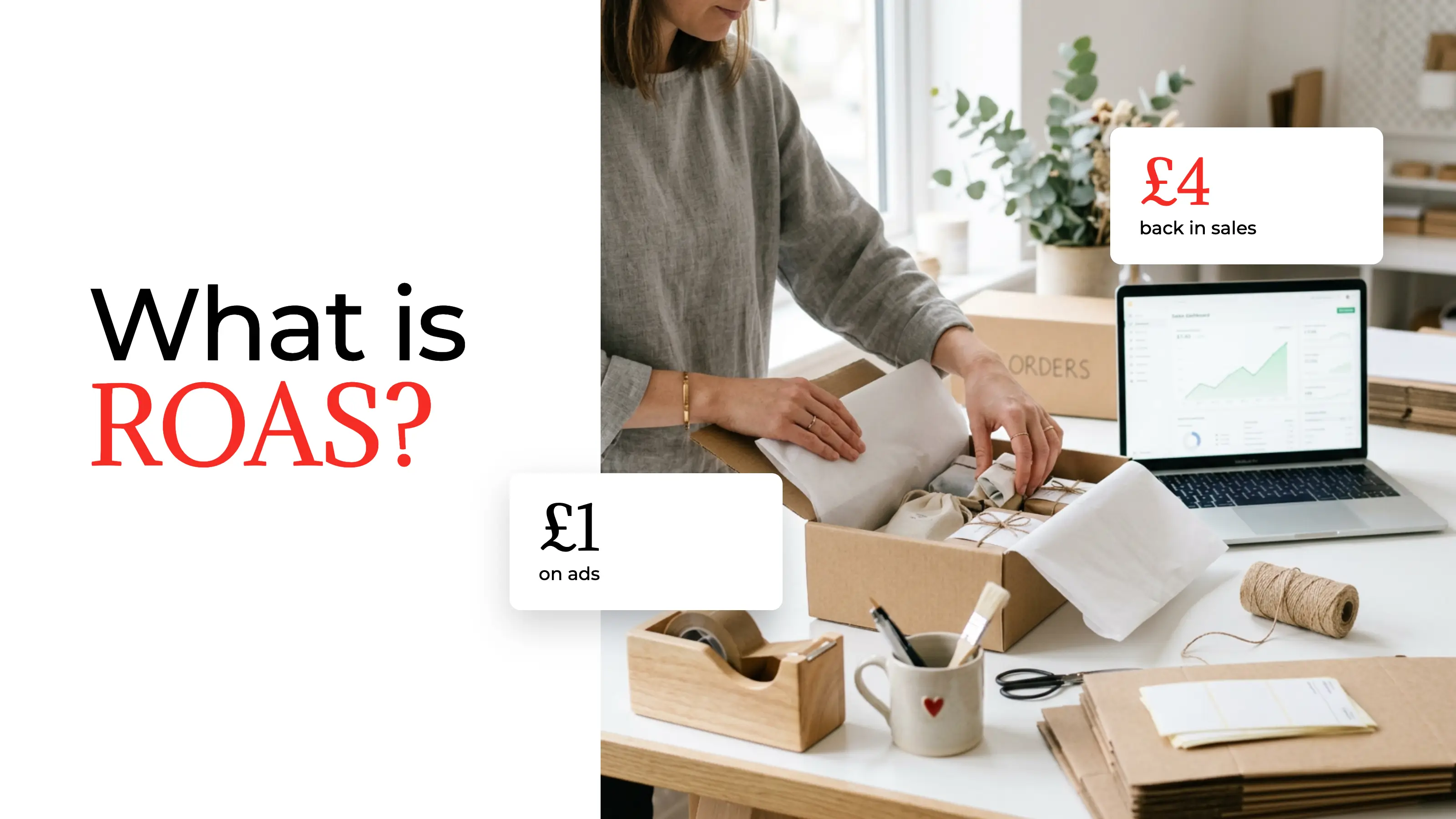
ROAS stands for return on ad spend. Put simply, it tells you how much money you make in sales for every £1 you spend on ads.
For example, if you spend £100 on Facebook ads and those ads lead to £400 in sales, your ROAS is 4. Every £1 you spent brought back £4 in sales.
You might see this written as 4, 4x, 4:1 or 400%. Don't let that confuse you - they all mean the same thing.
ROAS is useful because it links your ad spend directly to sales. Likes, clicks, and views are nice to see, but sales keep your business running.
How Do You Calculate ROAS?
You only need two numbers: how much you spent on ads, and how much you made in sales from those ads.
ROAS = sales from ads ÷ money spent on ads
Let's say you sell candles online. Last month you spent £500 on Google Ads, and those ads brought in £2,000 of orders.
£2,000 ÷ £500 = 4. Your ROAS is 4.
You don't usually need to work this out yourself. Google Ads and Meta Ads both calculate it for you. In Google Ads, it's labelled "Conv. value/cost". In Meta Ads Manager, it's called "Purchase ROAS".
What Is a Good ROAS for eCommerce?
This is the question everyone asks, and the honest answer is: it depends on how much profit you make on each sale.
You'll often hear that a ROAS of 3-4 is "good". That's a reasonable starting point, but it can be misleading. A ROAS of 4 might be brilliant for one shop and losing money for another.
Start With Your Break-Even ROAS
Your break-even ROAS is the point where your ads pay for themselves. Below it, you're losing money. Above it, you're making a profit.
To find it, you need your profit margin. That's the percentage of each sale you keep after paying for the product, packaging, delivery and payment fees (but before ads).
Break-even ROAS = 1 ÷ your profit margin
So if you keep 40% of each sale, your break-even ROAS is 1 ÷ 0.4 = 2.5. You need to make at least £2.50 in sales for every £1 spent on ads, just to cover your costs.
Here's how different margins change the number you need to hit:
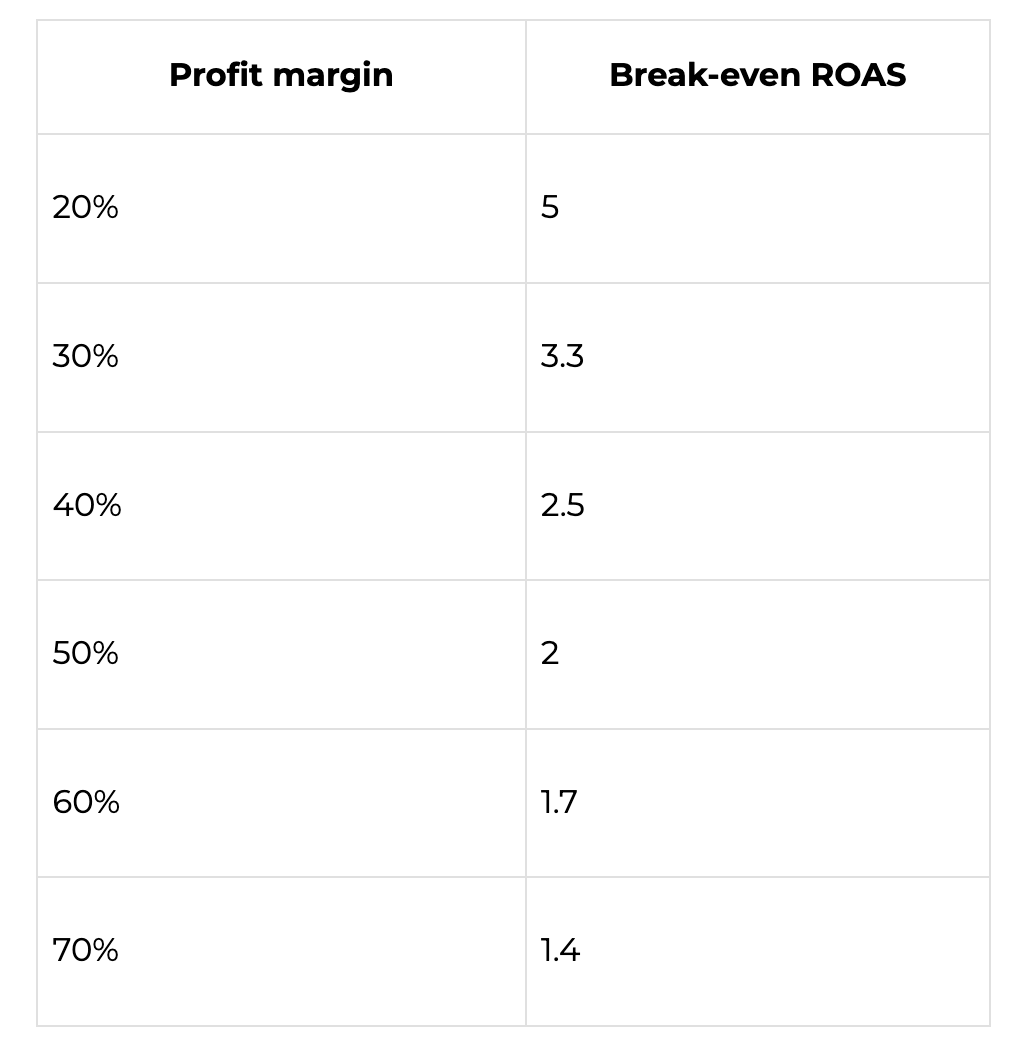
This is why there's no one-size-fits-all answer. A skincare brand keeping 70% of each sale makes a healthy profit at a ROAS of 4. An electronics shop keeping 20% would lose money at that same ROAS.
Think About What You Want to Achieve
Once you know your break-even point, your ideal ROAS depends on your goals.
- Want more profit? Aim well above your break-even ROAS.
- Want to grow fast or launch something new? You might accept a ROAS closer to break-even to win more customers.
- Do customers come back again and again? You can afford a lower ROAS on their first order, because you'll make more from them over time.
-
ROAS vs Profit: What's the Difference?
It's easy to assume a high ROAS means you're making money. That's not always true.
ROAS only looks at sales. It doesn't account for what it cost you to make, pack and ship those products. Profit is what's left after all of that.
If your margins are thin, or you're running big discounts, you can have a ROAS that looks great and still make very little money. ROAS is a useful guide for your ads, but profit is the number that matters most.
Why Your ROAS Might Not Be Accurate
The ROAS you see in Google or Meta isn't always the full picture. Here are three common reasons it might not match what's in your bank account.
Your Tracking Isn't Set Up Properly
Your ad platforms rely on tracking code on your website to know when someone buys. If that tracking is missing, broken or counting sales twice, your ROAS will be wrong. It's common to see Google, Meta and Shopify all showing different sales figures for the same month.
Google and Meta Both Take Credit
Imagine a customer sees your Instagram ad, then a few days later searches for you on Google and buys. Meta and Google may both count that sale as theirs. Add their figures together, and it looks like you made more than you did.
Some Customers Would Have Bought Anyway
Ads shown to people who already know you, such as when they search your brand name, often show a very high ROAS. But many of those people were already planning to buy.
A Simple Way to Check
Take your total sales for the month and divide them by your total ad spend across every platform. This is sometimes called your blended ROAS. It's less detailed, but it's much harder to fool. If your ad platforms say things are improving but this number isn't, it's worth digging deeper.
How to Improve Your ROAS
There are two ways to improve ROAS: make more sales from the same ad spend, or spend less to make the same sales. Here are six practical places to start.
1. Check Your Tracking
Before changing anything else, make sure your sales are being tracked correctly. If the numbers are wrong, every decision you make from them will be too.
2. Improve Your Product Listings
If you use Google Shopping, your product information is your ad. Clear product titles using words people actually search for, good photos and accurate prices all help your products appear for the right searches.
3. Spend More on Your Best Sellers
Not every product deserves the same budget. Put more money behind products that sell well and make you a good profit, and less behind those that don't.
4. Stop Paying for the Wrong Clicks
Look at the searches that trigger your Google ads. If people are finding you with searches that will never lead to a sale (for example, "free" or "jobs"), you can block them so you stop paying for them.
5. Make Your Website Easier to Buy From
Ads can only bring people to your shop. If pages are slow, delivery costs are hidden, or checkout is complicated, people will leave without buying. Small improvements here can lift your ROAS without spending a penny more on ads.
6. Encourage Bigger Orders
If each customer spends more, your ROAS goes up automatically. Product bundles, free delivery over a set amount and "you might also like" suggestions can all help.
So, What's a Good ROAS?
A good ROAS is one that's comfortably above your break-even point and supports your goals as a business.
There's no magic number that works for every online shop. Work out your own break-even ROAS, set your targets around it, and keep an eye on profit as well as sales. Do that, and ROAS becomes a genuinely useful tool rather than just another number on a dashboard.
Need Help Improving Your ROAS?
At BAW Creative, we build PPC campaigns around your margins and growth goals, not just what the ad platforms report. If you'd like a second opinion on how your ads are performing, book a discovery call with our team.